About Us
Mohamed Nemar Abuadas Establishment is a pioneering leader in hydraulic maintenance and services in Saudi Arabia, headquartered in Riyadh.
Mohamed Nemar Abuadas Establishment is a pioneering leader in hydraulic maintenance and services in Saudi Arabia, headquartered in Riyadh.


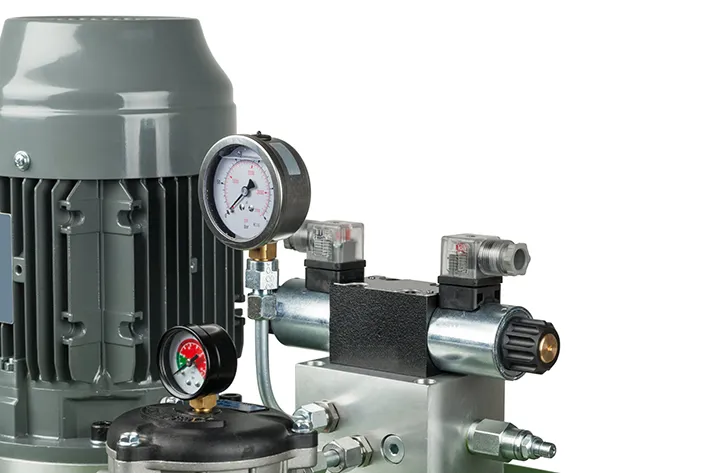
Older hydraulic power units can waste up to 30% more energy than modern equivalents. Replacing worn pumps, upgrading directional control valves, and integrating variable-displacement technology delivers measurable gains in system performance, fluid life, and operating costs — with ROI typically under 18 months.
Older hydraulic power units show their age through characteristic symptoms: excessive heat generation that requires the cooling system to run constantly, higher-than-normal noise levels from worn pump internals, frequent filter replacement due to internal wear particles, and sluggish response times that affect machine cycle rates.
If your HPU is more than 10 years old and requires more than two unplanned maintenance interventions per year, the economic case for upgrade or partial refurbishment is almost always justified when total cost of ownership is calculated correctly.
Energy efficiency has improved dramatically in hydraulic technology over the past decade. Modern pumps and valves can deliver the same or better performance with 30–50% less energy consumption. The savings from reduced electricity alone often justify the upgrade investment within 18–24 months.
For systems experiencing frequent failures or performance issues, our article on <Link href="/blog/hydraulic-cylinder-failure-causes">Common Causes of Hydraulic Cylinder Failure</Link> may help identify whether component issues stem from the power unit or other factors.
Fixed-displacement pumps — which move the same volume of fluid per revolution regardless of system demand — are the biggest source of energy waste in older hydraulic systems. They require a pressure relief valve to dump excess flow when demand is low, converting hydraulic energy directly to heat.
Variable-displacement pumps, particularly pressure-compensated and load-sensing types, adjust their output to match what the system actually needs at each moment. In systems with intermittent demand — common in manufacturing and lifting applications — this single change typically reduces hydraulic energy consumption by 30–50%.
Load-sensing pumps take efficiency further by monitoring actual system pressure demand and adjusting pump displacement accordingly. This technology is particularly effective in multi-actuator systems where demand varies significantly between different operations.
Modern variable-displacement pumps also offer better control precision, smoother operation, and longer service life compared to older fixed-displacement designs. The improved performance often enables higher machine productivity.
Older spool-type directional control valves develop internal bypass leakage over time, causing cylinder drift, loss of holding force, and wasted pump output. Upgrading to modern proportional or servo valves provides precise flow and pressure control, eliminating drift and improving positioning accuracy.
For applications that do not require proportional control, modern cartridge-style directional valves offer significantly lower leakage, faster response, and better reliability than older manifold designs.
Proportional valves enable electronic control of flow and pressure, allowing integration with PLC systems and automation. This capability opens possibilities for advanced control strategies that improve product quality and reduce cycle times.
Consider valve manifold consolidation during upgrades. Modern integrated manifines reduce piping connections, potential leak points, and installation complexity while improving system reliability.
An undersized or poorly designed reservoir contributes directly to overheating. The general rule is that reservoir volume should be 3–5 times the pump's output per minute — many older systems fall well short of this. Adding a properly sized reservoir with return-line filtration and a heat exchanger dramatically extends fluid life.
Upgrading from single-element return-line filters to duplex filtration units with differential pressure indicators allows filters to be changed without stopping the machine — critical for 24-hour production environments.
Install magnetic filtration to capture ferrous particles that standard filters miss. This additional protection extends pump and valve life by removing abrasive particles before they cause damage.
Consider offline filtration systems that continuously circulate and filter fluid even when the main system is idle. This maintains fluid cleanliness between operating periods and extends overall fluid life.
The ROI calculation for a hydraulic upgrade is straightforward: measure your current energy consumption on the hydraulic drive (kWh per production hour), estimate the reduction from variable-displacement pumps and improved valve efficiency (typically 25–40%), then multiply by your electricity cost per kWh and operating hours per year.
For a typical Saudi industrial facility running 16 hours per day, 300 days per year, a 30% reduction in hydraulic energy consumption on a 22kW pump motor saves approximately 31,680 kWh per year — at SAR 0.18/kWh, that is SAR 5,700 annually from one machine. Most upgrades pay back within 12–24 months.
Beyond energy savings, factor in reduced maintenance costs, improved product quality from better control, increased production capacity from reduced downtime, and extended component life. The total ROI often exceeds the energy savings alone.
We provide detailed ROI analysis as part of our upgrade assessment service. This analysis considers all relevant factors and provides a clear business case for the investment.
For facilities with budget constraints or multiple hydraulic systems, consider a phased upgrade approach. Prioritize the systems with highest energy consumption or worst reliability issues, then spread upgrades over multiple fiscal years.
Partial upgrades focusing on the most inefficient components — typically the pump and control valves — can deliver significant benefits without replacing the entire power unit. This approach reduces initial investment while still capturing most efficiency gains.
Consider refurbishment as an alternative to full replacement. Some components — reservoirs, piping, and certain valves — may be serviceable while pumps and controls are upgraded. Our assessment identifies which components can be retained.
Plan upgrades during scheduled shutdown periods to minimize production disruption. Proper planning and preparation ensure smooth implementation and rapid return to operation.
Modern hydraulic power units can integrate seamlessly with PLCs, SCADA systems, and industrial IoT platforms. This integration enables remote monitoring, predictive maintenance, and automated performance optimization.
Install pressure, temperature, and flow sensors on key system points. Connect these to monitoring systems that track performance in real time and alert operators to developing problems before failures occur.
Energy monitoring capabilities allow you to track hydraulic power consumption at the system level. This data supports energy management initiatives and helps identify opportunities for further efficiency improvements.
For comprehensive system care including power units and all hydraulic components, refer to our <Link href="/blog/preventive-maintenance-hydraulic-systems">Preventive Maintenance</Link> framework for ongoing system optimization.
Interested in upgrading your hydraulic power unit? We assess your existing system, recommend the right upgrade path, and provide a detailed cost-benefit report before any work begins.
Get a Free Consultation
فنيون معتمدون. قطع غيار أصلية. تغطية شاملة لكافة أنحاء المملكة.